Tuesday, January 9, 2024

Day 4: Turkish and Islamic Art Museum, Turkish Archeological Museum, and Travel to Pamukkale

 Day 4: Turkish and Islamic Art Museum, Turkish Archeological Museum, and Travel to Pamukkale 


Our last day in Istanbul was a cold rainy one full of museums. Throughout both museums we visited today, we often connected to themes of anti-materialist Muslim culture, and the Turkish desire to collect material symbols of their power. The first stop today was the Turkish and Islamic Art Museum located in the Hippodrome area in the palace of Pargali Ibrahim Pasha, a close advisor of Suleiman the Magnificent. The museum had many different exhibits displaying art and describing the historical period surrounding it, however the holy relics were the most emphasized.


The holy relics were a very important exhibit in the museum. For 400 years, the holy site of Kaaba was under Ottoman rule, so when parts of it like doors and locks stopped working, the Turks would make new ones, and store the old ones as holy relics. The other half of the exhibit contained artifacts related to the prophet Mohammed. The exhibit displayed things like Arabic descriptions of Mohammed, and the prophet’s beard hair. I was surprised to find that the hair was barely visible, so you had to have some level of faith that it was there. It was interesting how much importance was put on these artifacts considering the aversion of Muslims to material objects and idolatry. 


We then made our way to the Turkish Archeological Museum. The museum was founded in 1891 by Osman Hamdi Bey after he studied archeology in Europe. One of his greatest finds was a tomb (pictured below) with the only likeness of Alexander the Great created by people who may have known him. He helped discover some other tombs, like one depicting ancient women paid to cry at funerals, and one Egyptian sarcophagus that had been repurposed and used to bury someone in Lebanon.


The museum included a large section full of different Greek and Roman statues. This section offered a lot of insight into how Turkey's Greek and Roman past interacts with its current Muslim culture. The Greek art was largely detailed depictions of human bodies in motion, and the Greeks believed the healthier your body is, the better your soul is. However, Muslims have little attachment to the body, and ban depictions of humans in their art. Greeks also believed that women should be covered up both because they were expected to be matronly, and because it was believed that they were more susceptible to harm and possession. There is a similar standard of modesty and desire to “protect” women in modern day Turkey.


We ended our day with some free time to explore the rest of the museum, and after lunch, we traveled to Pamukkale. 

Thprophet Mohammed's beard hair 

Tomb depicting Alexander the great 


Day 3: Blue Mosque, Little Hagia Sophia, and Topkapi Palace-Annika Clark

We started off our day by visiting the very ornate and beautiful Blue Mosque, also known as the Sultanahmet Mosque. The Blue Mosque, since it was not converted from a church to a mosque, had a lot of pleasing symmetry and attention to detail that the Hagia Sophia lacked in comparison. For example, it was built so the mihrab was facing towards Mecca which made the building again feel more symmetrical because it had not been moved like in the Hagia Sophia. Also, after completing the readings of the four specific symbols that we typically see in mosques, they became much more noticeable and identifiable. The most prominent symbols for me were the symbols of paradise, and these were seen in the Blue Mosque through the abundance of windows (265), which then created an abundance of light, the decorations of the mihrab, as well as the floral designs on the tiles, and finally the ablution fountains on the outside. From the reading, it was mentioned that according to Islam, humanity destroyed the perfect world that was given by God, so the mosques attempt to evoke that sense of paradise to remind people of the perfection that the world once had. These reminders of paradise that I mentioned above have been seen in many of the mosques that we have seen thus far.


Moving on past the symbols, I also wanted to talk about what makes the Blue Mosque unique compared to the other mosques. While I already mentioned the ornate structure, what also sets it apart from other mosques is the design, architectural plan, and the number of minarets. For the design piece, the Blue Mosque uses these gorgeous blue tiles that the Turks almost created their own way of tile making, simply from the technique they used of double kilning and the specific temperature they used to get those bright colors used to adorn the mosque. For the architectural plan, they started off with one dome and then if they wanted to add more domes they added more pillars, however; as the space grew the pillars separated the people in the space. The people did not like the separation and instead wanted a unity of space and that was achieved with a very introverted architectural plan that involved the big dome being supported by half domes, and then half domes being supported by quarter domes, and so on. This mosque design later became used as a layout for later mosques because of its clear effectiveness. Finally, the Blue Mosque differs in the number of minarets because it was the first mosque to have six minarets. Technically a mosque only needs one minaret to function, but it became a tradition for imperial mosques to have more than one.

After the Blue Mosque we made our way to the Küçük Ayasofya, or the Little Hagia Sophia, which got its name due to its resemblance to the Hagia Sophia, but it was significantly smaller. Even tho fin the size of the mosque was small, it was still very interesting due to its unique origin story. Like the Hagia Sophia, it also was a church later converted into a mosque, but while it was a church it was dedicated to these two martyrs, Sergius and Bacchus, who later became important figures and saints in the Christian religion. They were Roman soldiers who converted to Christianity and were willing to die for their faith. As apart of them being martyred, there was an additional humiliation piece of them being mocked and put in women’s clothing, and this added a new gendered layer and perspective to their story that represents the gender roles during the time. Furthermore, these two martyrs were also said to have a partnership or relationship and can be perceived as homosexuality. However, that piece of their story was often overlooked or erased in history because it was not Orthodox. I loved learning about the pieces of history that are purposefully overlooked, especially when it comes to queer pieces of history.


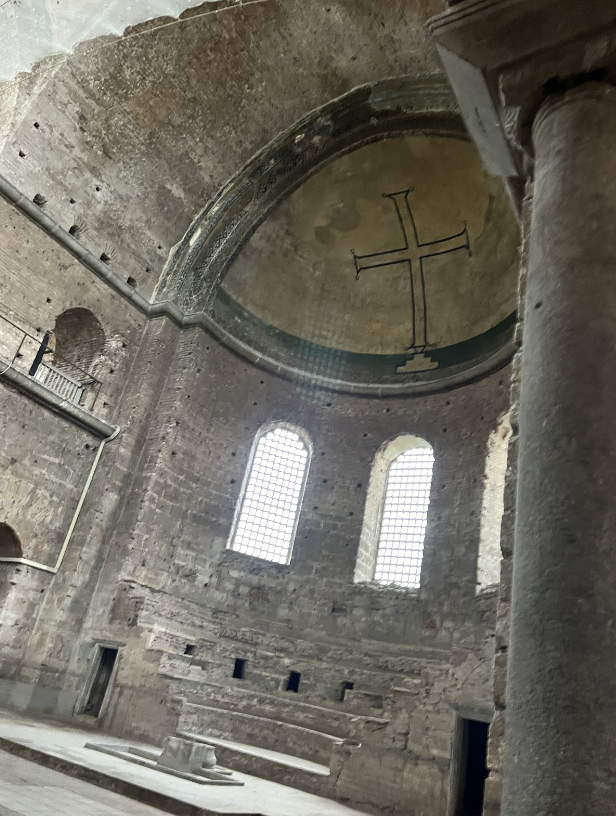
After the Little Hagia Sophia, we visited the Hagia Irene which was an earlier church than the Hagia Sophia and wa sized as an official church beside the Hagia Sophia was built. The Hagia Irene was also unique because it was during the iconoclasm where no icons were being painted or drawn so instead of the traditional murals that we may be used to there were simply crosses instead.


We then moved on to Topkapi museum where we discussed the intricacies of the Ottoman Empire and how the Turks selectively claimed their history. The Museum was full of many exhibits to see which included the main parts of the palace, the library, the treasury, the armory, and more. The highlight of this museum for me was learning more in depth about the women in the harem and the social norms during that time. We were also able to touch on the perception of one woman, Roxelana. She was perceived as evil for killing other people’s sons to ensure success for her own, and many people today do not question that narrative. However, we were able to discuss her actions and how many women during the time when they were simply trying to do what was best for them and their family were still perceived as evil. Even though she was killing other people’s sons which is undoubtedly wrong, they would have killed her son anyways if he had not been a ruler so the whole system was messed up. Anyways, what a day!! We saw soooo much and I can’t wait for tomorrow.


Monday, January 8, 2024

Prof Pics #2

Obligatory group pic at the Sultan's Palace (Topkapi)

New guide, Barcen, spots one of the Sultan's parrots

We consider the ethics of harem life

Althea, Olivia, and Avery plot to rob the
treasury.

Blue Mosque inspires silent adoration

Subdued Sass from Sarah and Anna


Sunday, January 7, 2024

Day 2: The Hagia Sophia, the Suleymaniye Mosque, Sveti Stefan Church, and the Greek Orthodox Church -Nancy Mueller

 We headed out early this morning, snagging a spot in line to enter the Hagia Sophia. Constructed by Emperor Justinian between 532 and 537 CE, the Hagia Sophia first served as a Christian church during the Byzantine Empire. After the Ottoman conquest of the city in 1453, the Hagia Sophia was repurposed as a mosque and remained this way until it was secularized by the young Turkish Republic in 1934. From 1935-2020 the Hagia Sophia functioned as a museum, and today it is once again an operating mosque. 


While touring Hagia Sophia we discovered that mosques are designed to recreate paradise on earth, often incorporating features such as light, symmetry, water features, and gardens to achieve so. Geometry also plays a role in mosque architecture as circles represent the perfect form of God while squares relate to the earth and humankind. I found it interesting that the artwork found in mosques is not images, but stylized script to prevent the worship of icons. The Hagia Sophia is unique in this respect as it contains several mosaics from its time as a church, several of which are still visible. It is also interesting to note that while symmetry is valued, the mihrab (a niche found at the front of the mosque to point worshipers toward Mecca) is off-centered as the Hagia Sophia is not correctly oriented having been built first as a church. 


(Above is a mosaic depicting emperors Constantine and Justinian gifting the Virgin Mary the Hagia Sophia and the city of Istanbul- of which she is now the patron saint.)


(The image above is an example of how mosaics inside the Hagia Sophia are covered as the building functions as a mosque. You can also see an example of stylized script artwork.)

After exiting the Hagia Sophia we were introduced to some of Istanbul's wetter weather. But after warming up with lunch (and maybe some Turkish coffee) we traveled to the Suleymaniye Mosque. Constructed under Sultan Suleymaniye in the 16th century, the mosque sits atop a hill overlooking the Bosphorus Strait. The complex includes the mausoleums of Sueymaniye and his wife Roxelana, a cemetery of other nobility, and a school for religious studies. Originally there was a public kitchen, a hospital, and even a medical college! Nearby lies the tomb of renowned Turkish architect Mimar Sinan who designed Suleymaniye Mosque himself. In only fifty years Sinan created over 350 structures, including 81 other grand mosques. Sinan also engineered a suspension system upon which the four minarets stand, allowing them to survive several earthquakes over the centuries. 


We finished out the day with a visit to the Greek Orthodox Church, Sveti Stefan. Made entirely of iron this portable church was first constructed in Bulgaria before being assembled in Istanbul. While the Turkish Greek Orthodox population is waning, there is still a strong local community to the church. On the way back we stopped at the seat of the Greek Orthodox patriarch and visited the public chapel. Seeing the nativity scene here we realized today is Orthodox Christmas!


(Interior of the Sveti Stefan Church)


Prof Pics #1


This would be a good album cover...if Evan was the front man of 
a band with Izzy, Nancy, Adam, and Annika


Adam and Kathan seem to think they're at a club
called "Holy Wisdom"

Some of our people rockin' their head coverings in
Hagia Sophia


Willing to wait to see one of the oldest, biggest
things in the world.

Avery knows something you don't.

Kathan considers Theodosius' role in the spectacle
of the chariot races.

We put the "study" in study abroad as we consider the
stories of the Hippodrome.

First group shot (sorry Izzy)

Saba discusses which of us will be thrown in 
the dungeon.

Izzy is the most keyed-up for our first day of touring.

Saturday, January 6, 2024

Day 1: Theodosian Walls, Basilica Cistern, & Hippodrome - Seleyna Bautista

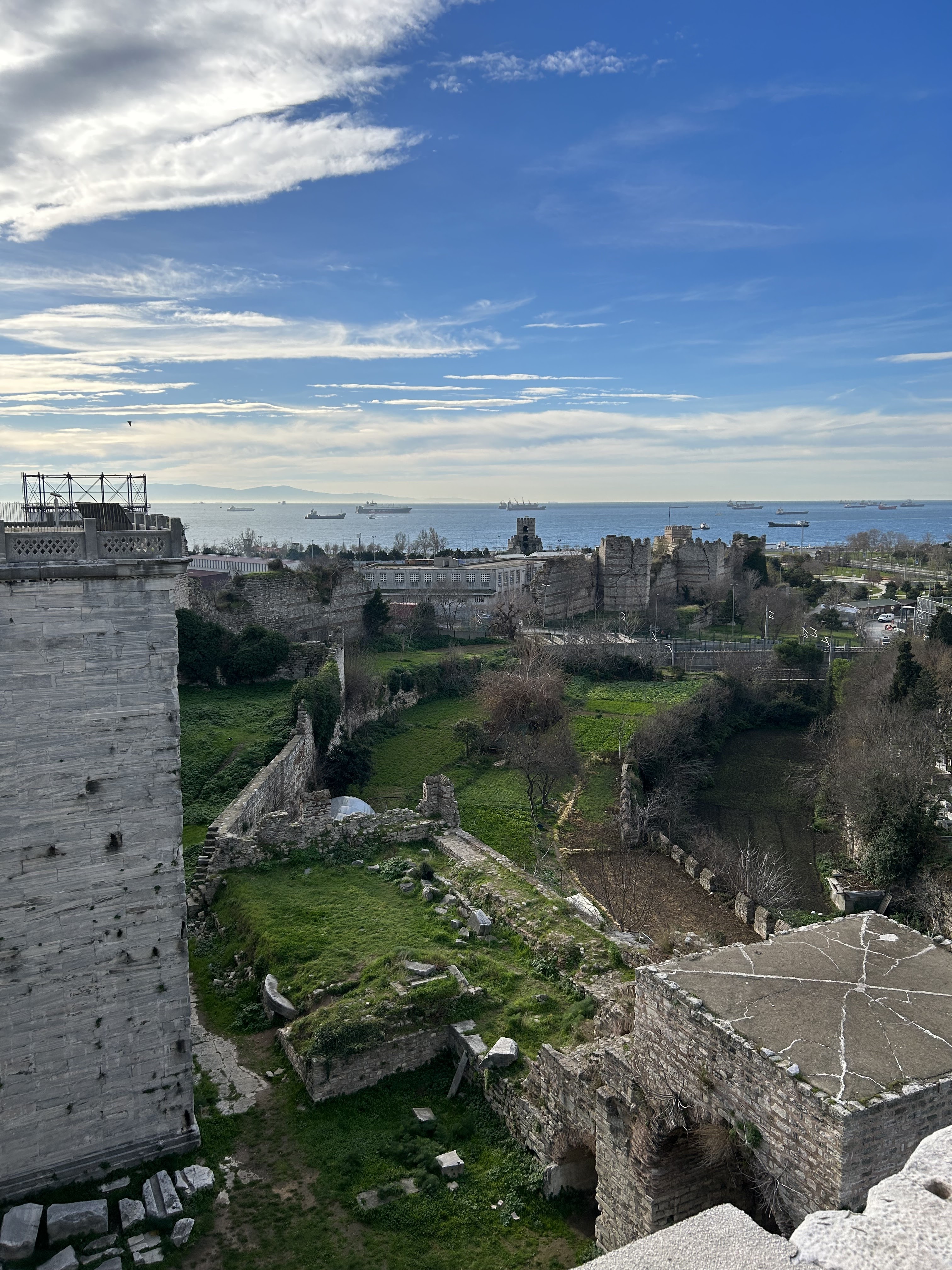
On our first day in Istanbul, we met at 10:00am to visit our first spot of the course, the Theodosian Walls.  The Theodosian Walls stretch all the way around the peninsula of Istanbul, which protected the city from attacks from the sea.  Additionally, from a bit further south of the Yedikule Fortress to the Golden Horn, the Theodosian Walls prevented potential enemies from entering through land.

While we were unable to view every part of the walls, we did visit the Yedikule Fortress, which is an heirloom of Mehmed the Conqueror.  The Yedikule Fortress is home to the Golden Gate, which was a gate used to welcome special guests, such as other emperors. The Yedikule walls consisted of 4 layers (walls, a moat, more walls, and the fortress), to slow down enemies as much as possible.  Today, the fortress and the walls are being restored to its former glory while also being used as an event venue, for art, culture, and even weddings!  

At the top of this fortress, we discussed other ways that people might defend a city.  One such way is through religion.  For example, when a siege on the walls occurred, many people claim to have seen Virgin Mary herself grab the invaders by their hair and toss them away from the walls, protecting its citizens and allowing Constantinople to live another day.  Before leaving for Turkey, we discussed Thomas Tweed’s definition of religion and how religion can be used to cross boundaries.  After learning how religion is able to defend a city, it suggests how religion can also be used to create physical boundaries between people.


After exploring the Yedikule Fortress, our bus drove us along the line of walls while heading back to our hotel.  While the majority of the walls were not in the best condition, there are many restoration projects being done to the walls to restore them to their former glory.  It’s interesting to see how different the old stones are from the newer stones and how erosion can greatly affect a wall that many invaders had trouble destroying.  Whether it be through water or wind, it shows how powerful nature is overtime.


Speaking of water, one tactic that was used often when trying to conquer a city was to surround the city on all sides and wait for the city to surrender by cutting off their food and water supply.  In cities such as Rome, the only way for them to get fresh water was to create aqueducts that ran all the way from Bulgaria which was approximately 150 miles away from Rome.  This meant that if someone wanted to invade Rome, one way they could weaken them was by poisoning their water supply.  

Even though Istanbul had walls to protect their city from immediate attacks, the city still needed something to sustain them if their food or water supply were to ever be cut off.  Underneath their city, the people of Constantinople built a water supply that could supply its citizens with water for up to a year if their water supply were to ever be cut off.  This place is called the Basilica Cisterns and was built in 537 around the same time the Hagia Sophia was built.

Due to its immense size and pillars, the Basilica Cistern also goes by the Sunken Palace, however, due to the inconsistency of the types of pillars used, we discussed how it was unlikely that this place was a palace.  The inconsistency of the types of pillars used suggests the latin word, spolia, or stones that are taken from old structures and are repurposed in new construction or decorations.  Spolia can be seen in many different parts of Istanbul which suggests that Istanbul takes pride in their historical architecture and history.  This word reminded me of my COR class that I took in my fall semester and how cities might repurpose old buildings or areas to better suit the changing environment.  It also makes me wonder how other cities might also preserve their history.


Another part of the Basilica Cistern that I found interesting were the Medusa heads at the bottom of two pillars.  We discussed the purpose of these heads and why they were put here.  Some people believe that they were used as an example for the length and width the pillars had to be to support the underground place, while others believe that it was used as a symbol for the end of pagan religions.  I like to believe that it was used as a way to protect the Basilica Cistern and ensure that the water isn’t tainted.


The Hippodrome was our final destination on our first day in Turkey.  While the Hippodrome still exists in Istanbul, the majority of it is left underground, and its location has turned into a public area.


Hippodrome gets its name from the Greek word Hippo, or horse, and the Greek word Dromos, or tribute/race.  This provides a self-explanatory explanation for what the Hippodrome was mainly used for in the past, horse and chariot races and celebrations.  The Hippodrome is approximately 400 meters on both sides.  That’s twice the size of a regular outdoor track!

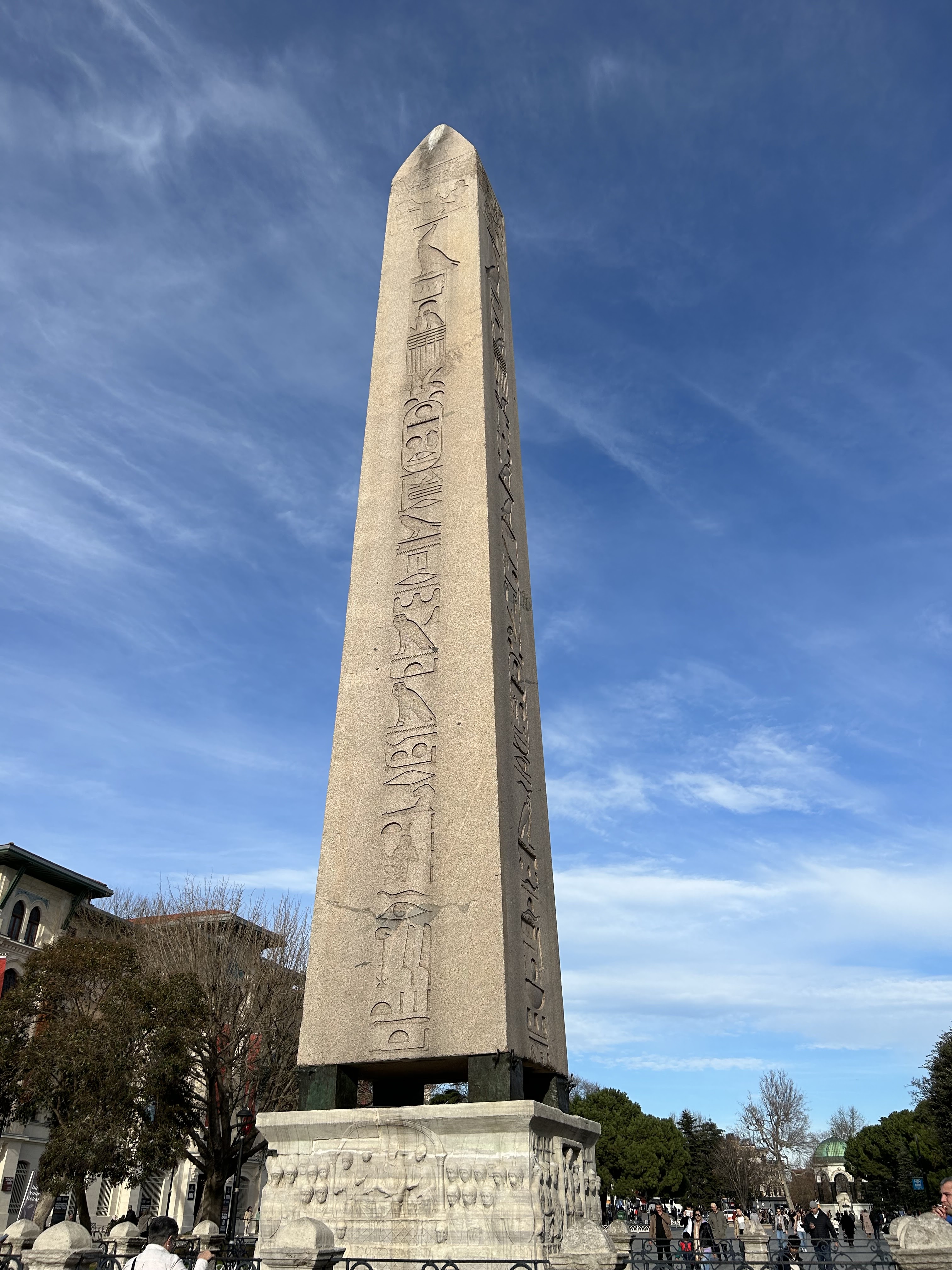
The Hippodrome also houses structures from other countries.  For example, a fountain from Germany, a bronze structure from Apollo’s temple in Delphi, Greece, and a stone obelisk from Rome.  My favorite structure present at the Hippodrome was the Obelisk sent by Egypt.  I found this one most interesting due to the hieroglyphics on it and due to how pristine and clear it looked despite being 36,000 years old.

Friday, January 5, 2024

Hoş Geldınız!

​We’re happy to say that we’ve arrived safely in Istanbul. It was a long day, but folks seem excited to be here! Tomorrow we’ll have a good breakfast and head out for a day of sights and a group dinner. 

Day 14: Neve Shalom, Jewish Museum, Galata Tower - Adam Reisman

Merhaba ve hoşçakal! (Hello and goodbye!) After visiting many great ancient sites, museums, mosques, and more, today marks our last officia...