Monday, January 15, 2024

Day 10: Turkish Parliament - Althea

 Today, we were able to visit the Turkish Parliament. The tour took us through much of the building, telling us about the history along the way. In the entrance, there are two small gardens to either side, one which still shows some damage from an attempted coup in 2016. Then we moved on to the General Assembly room, where they explained the ideas behind the setup of the room. 


Damage from the 2016 attempted coup

The General Assembly


There are seating areas for the 600 members of parliament, the President, other government officials, the press, and the public. 


After, we went through a tunnel connecting two administrative buildings that contained murals on the walls and ceiling that represented important aspects of major cities in Türkiye. It was interesting that we were able to recognize quite a few sites despite only being here for a short time, such as the Hagia Sophia and the remains of the library in Ephesus. 


The next portion of our journey was informative. We were given a presentation on the way bills are passed in the Turkish governmental system. The first part of the presentation was how the party system worked. There are 600 members of parliament, 15 represented parties, and 6 official post groups currently. A party needs 20 members to become a group, where they can have influence in the committees of government and decide the agenda of parliamentary meetings. They currently have a majority formed through a coalition of their two major parties. Their system of passing laws is somewhat similar to the United States, except with a unicameral system. A bill needs to be approved and proposed by a committee, sent to parliament, and then approved by the president. If the president vetoes the bill, then parliament can amend it and send it back, or vote to peg it despite the veto. 


The biggest part of this visit was the opportunity to meet Nevzat Pakdil, former Vice Speaker of the Grand National Assembly and current member of the Turkish Parliamentary Association. He gave a small speech about the importance of peace, and sharing the world with others despite our differences. It roughly translated to the idea that the world is for all of us, we need to keep it clean and in peace, and that it is in our hands as students. It was an interesting opportunity that differed from what we have talked about previously in this course, and it was an opportunity I was glad to have as a way to see and understand more of Türkiye. 


More Pictures


Mike teaching about the Turkish Republic in Izmir.


Going up? In Pergamum.


Our guide Saba in the gymnasium at Pergamum.


We've been working together for 11 years.


Day 9: A Walk Through Izmir - Kathan

Text

For the last three days our group has stayed in the city of Izmir, which lies in the same location as the ancient city of Smyrna.

Izmir is the third largest city in Türkiye (with a population of roughly 4.5 million people, behind Istanbul and Ankara) and is located right on the coast of the Aegean Sea, facing Greece.


Because of Izmir’s direct connection to the sea, it was an important piece of the Roman and Ottoman Empire as a main trading staple. After the conclusion of World War 1- which simultaneously sparked the beginning of the Turkish independence movement- Izmir became a place of Turkish revolution.


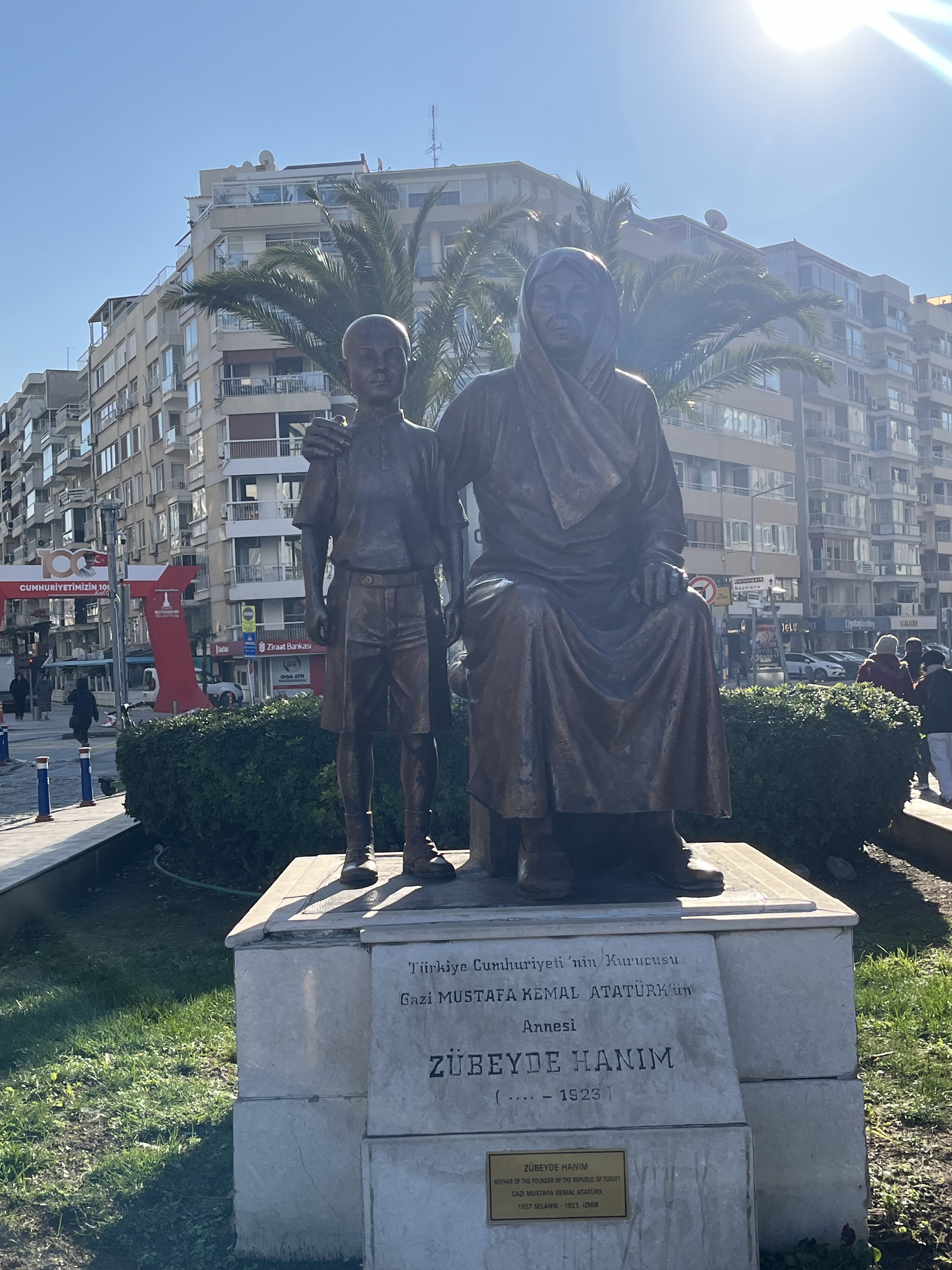
Today our group walked around city, and looked at several important statues located in the urban area. The leader of the independence movement, and later the first president of the Republic of Türkiye, Mustafa Kemal Ataturk, is plastered all throughout Izmir.


He’s framed in coffee shops, front row pictures at fashion shops, included in art along the pier, and probably anywhere else you can think of. 


This is for many reasons. 


First of all, Ataturk is widely considered to be the father of the modern Turkish Republic. He was the leader during the movement for independence and therefore is honored almost as a deity.


At the center of Izmir, there is a prominent statue of Ataturk. He is sculpted on horseback, facing Greece. Many say this is representative of his diplomatic policies toward the Greeks.


For backstory, Greece originally had occupation of the city of Izmir during Türkiye’s revolution. Many Greeks lived in Izmir and Türkiye as a whole. But following the founding of Türkiye as a nation, Ataturk was not tolerant of Greeks residing within his country.


This resulted in an event called ‘the swap’. Turks who lived in Greece were ‘traded’ for Greeks who lived in Türkiye on very short notice. Families were given very little time to evacuate their homes and flee the country. 


Therefore the statue of Ataturk leading his men into battle faces Greece, proclaiming the Greeks as a common enemy. Or in other words, a foe who need to ‘go back to where they came from’.


This as a whole, is a personification of the strong ethnic divides that Ataturk juiced into the nation at the peak of his powers. Anatolia was a place of cultural confluence, but the events of 1923 changed that for a long period.


However, on another note, the appearance of Ataturk is also a representation of progressive thought within the Turkish Republic.


In 1923, when Türkiye gained its independence as a nation, Ataturk led a movement of westernization throughout the country. For instance, he banned the wearing of the Fez, persuaded Turkish citizens to adapt to modern clothes, and changed the Turkish alphabet from Arabic to Latin script. 


Ataturk even granted women many rights within the country in efforts to elevate them to the same status as men. Taking things into context, this was long before countries like the United States would do the same. 


He built additional universities for women to attend, and his daughter became the first Turkish female pilot: becoming a role model for young Turkish girls.


As our tour guide Saba says, the closer a city is to the sea, the more liberal it tends to be. This is definitely the case for Izmir.


So, in a way, photos of and sculptures of Ataturk covering the city of Izmir are symbolic of their dedication to progressiveness. This dedication has become especially relevant in the modern day.


Current President Erdogan is leading a movement that some describe as “de-westernization”. This is best exemplified by his conversion of The Hagia Sofia from a museum back into a mosque.


Some see these acts as Erdogan turning his back on the European world and focusing on becoming a larger force in the Islamic world.


In many ways, Izmir’s devotion and idolization of Ataturk shows their pledge to progressive thought, and possible angst against the motives of Erdogan.


As Türkiye passes 100 years of being a nation, it has gone through many different phases of diplomatic policy. The way in which Izmir chooses to represent itself may be indicative of what the city in general chooses to align itself with, and what the future of Izmir and Türkiye may look like.


Overall, we enjoyed our stay in Izmir, and now look forward to the rest of today flying to Ankara: Türkiye’s capital.


We cannot wait to see what’s in store!


Saturday, January 13, 2024

Day 8: Ephesus & the House of the Virgin Mary — Claire


 Today we traveled by coach to the ancient city of Ephesus, located in modern-day Selçuk. At its prime, Ephesus was one of the major commercial centers of the Eastern Mediterranean world, and thus attracted lots of diverse peoples and cultures. It was the fourth largest city in the Roman Empire and functioned as its capital in Asia Minor. 

The first thing we saw upon arrival was the fabled house of the Virgin Mary, where, according to legend, Mary lived under the care of the Apostle John. We know that John did live in Ephesus, but there is no solid historical evidence that Mary lived there with him. People have interpreted as much from the Gospel of John in the Bible, which says that when Jesus was dying on the cross, he entrusted John to care for his mother like his own. 


Mary’s house.

The house is located atop a hill, at a distance of about 6 km from the main city of Ephesus. This is because in the first century AD, Christians faced persecution in the Roman Empire, so Mary was kept outside of the city for her protection. 


Our tour guide, Saba, told us that in the nineteenth century, a nun called Anne Catherine Emmerich, who lived in Germany her entire life, had a vision about the location of the house. When archaeologists began excavating Ephesus, they looked for the house based on where the nun had envisioned it to be, and they found it. 


As students visiting religious sites with intellectual curiosity in mind, our questions are not formed based on what is and isn’t true, but rather what people believe and why they believe it. Despite a lack of historical evidence, the site holds considerable religious significance. On our way out of the site we passed by a spring water fountain thought to contain holy water, and beside that was a wall covered in slips of paper, each containing a prayer or wish left there by past visitors. There is even a mass held inside the house on Sundays. 


The wall of prayers outside of Mary’s house.

The house serves as a modern pilgrimage site for Christians around the world, often filled with tour groups visiting with religious leaders. Mike shared an anecdote from a previous year when they couldn’t enter the house because a group of Korean Catholic priests were holding a service inside. #confluences.


After leaving the house, we drove back down the mountain to see Ephesus. On the way, we could see the beautiful Aegean Sea in the distance, which once reached all the way up to the city but has since retreated. Sea access was one of the features that made Ephesus such a successful hub of business. 


The fearsome guards of Ephesus.

The version of Ephesus we see today is only about 10% excavated, but there were still many sights to see! We saw the site that was once an agora (market), as well as the Egyptian temple beside it — evidence of the cultural diversity in the city. After that we took a look at a walkway that once served as a courthouse in the administrative part of the city. Behind that sat an Odeon — a small theater where performances (likely for the elite) were held. The theater also served as a bouleuterion, or council house. 


The Odeon

Next we passed by a twin temple, thought to honor both the emperor (possibly Julius Caesar) and Artemis, the goddess of fertility, to whom the city is dedicated. This, among other things, is evidence of lived religion in the city — its inhabitants valued their cults greatly. The Temple of Artemis was one of the seven wonders of the ancient world, but it no longer stands on site in Ephesus. The statue of Artemis, however, resides in the Ephesus Archaeological Museum. 


Beside the temple was the Prytaneion, where the governor would have worked. One of these governors is mentioned in the Acts of the Apostles in the Bible, as he saved the life of Paul from the angered citizens of Ephesus.


Remains of the Prytaneion.

We then descended down a sloped road further into the city. We could see where the Romans once carved horizontal lines into the stones to keep people from slipping. There were also stone bases lining the street that used to hold statues. 


Ridged stones on the street.


We visited the remains of a Roman bath, then passed by what appears, from the outside, to be a temple to the emperor Hadrian. The legend says that the Ephesians heard the emperor was visiting the city and got permission to build a temple for him there, but they didn’t have the space for the full structure. Instead they only built the facade, and carved the head of Medusa above the door. Hadrian, having a fear of Medusa, saw the carving and left without going inside!


Hadrian’s “temple.”


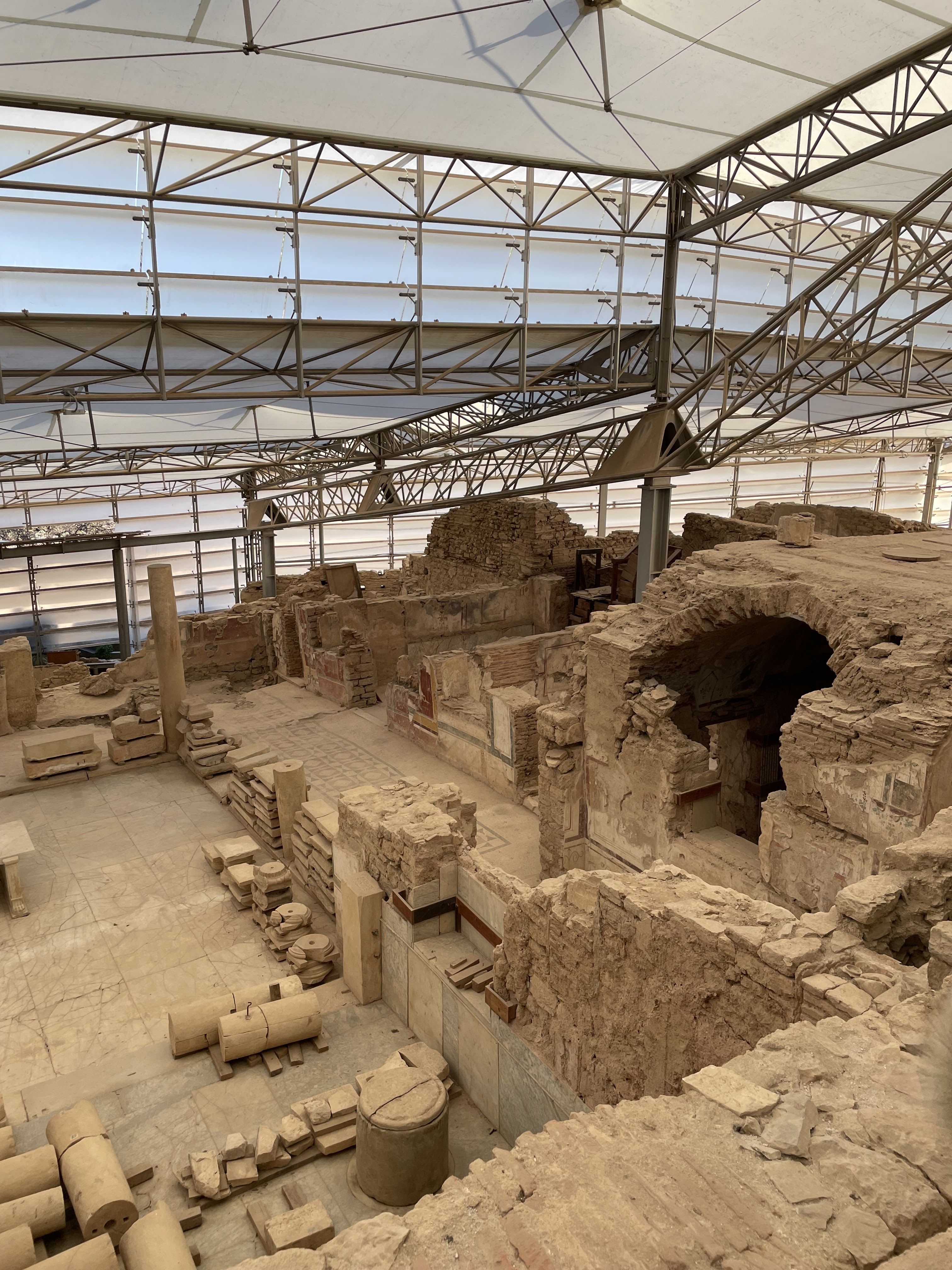
Next we walked through a recent excavation: the terraced houses that were once inhabited by the wealthy citizens of the city. On the way in we passed by a sidewalk mosaic, a common feature in wealthy homes and other significant buildings at the time. 


Sidewalk mosaic + a friend :)


One of our main focuses of the day was uncovering the stories of Ephesus that we don’t often focus on — that is, the lives of enslaved people. The terrace houses were owned by wealthy slave owners, and recently historians and archaeologists have looked for evidence of enslaved people existing within them. One example was one of the dining rooms we walked through, where there is evidence that the couches were placed so that slaves could maneuver behind them. This also highlights how enslaved people in ancient times were expected not to make their presence known; to disappear into the background. 


Another example was how in some rooms, the floors were designed to be heated by hot water circulating beneath them. We considered how that water had to have been heated by a furnace, and that furnace was likely stoked by a slave. These are just some of the ways in which we can look beyond the surface level of ancient ruins to get a more complex understanding of the lives of the people who inhabited them. 


Views of the terrace houses.

We then explored what is probably the most famous landmark in Ephesus: the library of Celsus. This is the only two-storey structure on the site, and was the third largest library in the ancient world. The philosopher Celsus is buried there. 


On your way up the stairs you might catch a glimpse of a bit of ancient graffiti — a menorah carved into the marble. 


Library of Celsus.

Menorah graffiti.


The last thing we saw before leaving was the theater of Ephesus. This theater could seat around 25,000 people — the largest theater in Asia Minor. It is still used for concerts in the summertime, and because the theater faces the sea, many of the musical performers don’t use any sort of sound technology, instead relying on the wind to carry the sound.


Theater of Ephesus.


Ephesus was super fun to explore, and we learned so much about this ancient city! (And we loved seeing all the cats and dogs, too.)


Prof Pics #5

Killer view from the Acropolis of Pergamum

It's Anna's blog-day so she's getting some great pictures too

Avery finds out Roman gymnasia were probably just for the boys

Lynn spots another old column

Claire knows where the camera is

As we enter the Asclepion (ancient healing center) our group wonders if there's a treatment
for their aching legs after a big climb down from the acropolis

Lynn and local dog whisper positive affirmations to the emotionally wounded marching through the tunnel


Day 14: Neve Shalom, Jewish Museum, Galata Tower - Adam Reisman

Merhaba ve hoşçakal! (Hello and goodbye!) After visiting many great ancient sites, museums, mosques, and more, today marks our last officia...